<body><script type="text/javascript"> function setAttributeOnload(object, attribute, val) { if(window.addEventListener) { window.addEventListener("load", function(){ object[attribute] = val; }, false); } else { window.attachEvent('onload', function(){ object[attribute] = val; }); } } </script> <iframe src="http://www.blogger.com/navbar.g?targetBlogID=14449015&amp;blogName=Blue+Eyed+Views+of+Mt.+Fuji&amp;publishMode=PUBLISH_MODE_BLOGSPOT&amp;navbarType=BLUE&amp;layoutType=CLASSIC&amp;searchRoot=http%3A%2F%2Fbevfuji.blogspot.com%2Fsearch&amp;blogLocale=ja_JP&amp;homepageUrl=http%3A%2F%2Fbevfuji.blogspot.com%2F" marginwidth="0" marginheight="0" scrolling="no" frameborder="0" height="30px" width="100%" id="navbar-iframe" allowtransparency="true" title="Blogger Navigation and Search"></iframe> <div></div>

火曜日, 7月 24, 2007

ABC is DOWN, suckaz

The post which inaugurated this blog was about a language school called ABC. Go to the archives and read about my first hand experiences interviewing with the place.

Anyway, to no surprise of anyone aware of the place, along with deceptive recruiting practices, deceptive advertising ("native speakers"? With heavy foreign accents, right.) and paying less than half the market rate, the company didn't pay anyone for last month, including office staff.

And then last Tuesday, the staff arrived at work but could not reach the owner/general manager. The guy cleaned out the general bank account and left the country.

Did I call this crap or did I call it?

ラベル: ,

土曜日, 12月 30, 2006

Delays

Toi Otosho O!
Sorry for the delays, readers. Refresh the RSS on the blogger page, because I hope to post pics when I get back from my New Years in Kyoto.

月曜日, 8月 14, 2006

Hot Summer, Cold Food

Summers in Japan are like Michigan summers, hot, wet, heavy tests of endurance. Osaka wilts under a lead grey sky in the low 30s and 95+ humidity. Kyoto is a bowl of suet and sweat. Yet Japanese businessmen will insist on black business suits and stoic expressions. The smarter gaijin are free to get away with offending the locals with t-shirts and shorts. Ah, freedom.
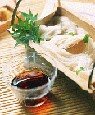
But there is respite. Noodles are the staple in Asia next to rice. You can find noodle dishes in every corner of Japan but what many Westerners may not know is that noodles can be eaten...cold!

Somen is a kind of limp white noodle that is best served in a deep dish, soaked in ice cold water and dipped by the strandful in a soy-sauce type of juice called 'yu-tsu'. The more adventurous will soak sliced mushrooms in the yutsu and quartered tomatoes and tofu in the somen dish. Very little garnish is needed.

Somen is best served and eaten cold with a side dish of edamame or green onion. This happens to be my favorite hot weather food. Once you try this, I hope I've made a convert of you!

火曜日, 5月 16, 2006

Short hiatus

Sorry for the lack of content. I've been a bit busy with other projects lately. I'll try to put something up next weekend! Thanks for your patience.

水曜日, 3月 22, 2006

Hanami

Hanami is the annual celebration of the cherry blossoms. Being a nature-oriented culture, Japan takes time out to observe seasonal occurrences, Spring being one of them. Hanami is not an officially sanctioned holiday but a culturally approved one. Because cherry trees bloom at different times of the year, students get the luxury of witnessing the first blossoms while office workers hope that the blossom stay long enough for the weekend.

Cherry blossoms don't last very long, a week and a half at the most. Therefore, it is Japanese tradition to observe hanami as a gesture appreciating the short span of life of the sakura (cherry blossom), and of human life.

How is hanami celebrated? Very simply. It is the one time out of the year when (except during baseball season) the Japanese can let go of their carefully composed behavior and let loose! Everyone has a picnic under the cherry trees, eating, drinking, laughing, moving from one picnic spot to the next where they visit old friends or make new ones. An American comparison might be the Fourth of July. Not that close, but its still a picnic or a barbecue, with some beer and sake, and beautiful flowers above you.

Hanami in Osaka and Kobe is supposed to begin the last weekend of March and runs through the first weekend of April. Tradition holds that the later hanami arrives, the shorter the summer. I certainly hope so.

土曜日, 1月 07, 2006

Geisha: Part Three, さゆり

WARNING: THIS MOVIE REVIEW CONTAINS SPOILERS!

About a month ago, there was an article in Japan Today about the controversy of authenticity in the then-upcoming movie, 'Memoirs of a Geisha' ('Sayuri', in Japan). Thinking that this would be a great article for my private students, to engage them on a cultural topic they already knew using English, I pared the article down and prepared a lesson plan. Surely every Japanese, especially the women, knew enough about geisha and Gion to initiate a conversation about what is authentic and what is portrayed on TV and movies.

To my surprise, several of my younger students
knew what a geisha was but they didn't know many of the important qualities. It seemed I knew more than one of my students who had trouble identifying a musical instrument in a picture. It was a koto, a traditional stringed instrument geisha are taught to use during dance recitals. My students could not differentiate the difference between a mai-ko and a gei-ko, though the mai-ko wear the brighter kimono and have the larger obi and hairpieces. Furthermore, tea houses were assumed to be places to sip tea, like Starbucks, not places where you drink sake and are entertained by gei-ko.

The reason why I am telling you this is to remind you of points I raised in the first two posts: the geisha world, and many other cultural elements in Japan, are disappearing.

So the trick is for a movie director to figure out how to present a story about the mysterious world the geisha live in, knowing there will be filters in place to distort the truth. The Japanese do it all the time, with their period dramas which depict geisha as courtesans of the night. The great Kurosawa himself took enormous liberties with authenticity and his earlier financiers almost shut him down until they realized they were making a lot of money off the guy.

So a filmmaker has some choices, knowing full well that an accurate portrayal of the subject simply is not possible. But how to revere the subject knowing that there are cultural and dramatic liberties which filter reality once removed from a book and is further removed with a movie. Rob Marshall, acclaimed director of 'Chicago', had to either be true to the cultural integrity of the geisha, or stay true to the book, or recognize there is that filter, the several removes from the subject, and move away a step further.

Let me give you an example: when I was traveling in Italy, ten years ago, I ate genuine pizza. Thin crispy crusts with a little sauce, some meat and vegetables and very little cheese. American pizza is wide, much thicker than the real the thing, and lathered with tomato sauce and toppings. In Japan, its American-style pizza but with Japanese items, mayonnaise, cold cucumber, corn and seaweed. Ergo, the real item, the American interpretation of the item, and Japanese interpretation of the American interpretation of the item. Bread topped with mustard, squid and cheese, a special at Pizza Hut according to the Japanese flier stuffed into my mail box this morning.

Marshall's choice was to 'base' his film on the book and distance himself as much as possible from the subject without alienating readers of the book. Marshall also recognized that his target audience must be the general American viewing public, not the Japanese and not Japanophile purists. So he Hollywood-ized the story.

The story very loosely follows details from the book but I emphasize loosely. The city is renamed. Certain elements are completely removed. World War II spans about four minutes. The last third of the book is excised. The US release version is a little different than the Japan version. Characters are replaced or renamed. But it is essentially the story of a little girl sold to slavery who eventually becomes the beautiful geisha, Sayuri.

Now my review: I loved 'Chicago' and I knew that this movie was going to have a lot more action, a la dancing, than the book. I also knew a lot of the talky bits were going to be reduced in favor of visual moments. I also think Marshall made the right decision to distance the movie from the book. But the movie, pure and simple, is a white man's fantasy inspired by another white man's fantasy of geisha. Marshall would hire traditional Japanese musicians to play some pieces and then he would say, "okay, now make it faster, add more beats." Huh? Wait, does he want authentic or does he want hip hop? Same goes for the training, which supposedly took six weeks and involved the actresses touring extensively around Kyoto. Um, no. You don't learn dance for six weeks and then have an American choreographer teach you completely different moves, but I guess this is what happened.

I have seen the Gion Spring Dances, open to the general public as they are. I will be seeing a performance this coming May, tickets cost $120. The cheap seats. These dances are, in a word, boring. Most of the audience sleeps through these things. Tourists soak in about thirty minutes and then they fidgety. The little emo performance art thing that is Sayuri's dance number halfway through the movie is nowhere near the same thing as what I will see.

Strengths:
-Stunning set design
-Beautiful kimono
-Superb performances by Watanabe/Yeoh/Li/Zhang&Co.
Weaknesses
-Every plot point or motivation leads nowhere, many sequences occurring for no reason at all
-At one point in the movie, I vowed if Sayuri said "I don't understand" one more time, I would reach out and wring her neck
-ESL English. I have to deal with it every day for work. I don't want to have to pay $15 to hear it for two and a half hours
What to do for the DVD release
-Cut an hour from the movie, it will make it tighter, thus stronger
-Require the material from the US and Japan be the same for the DVD
-Lose the dance number or incorporate another one that is closer to what a tourist might actually see if they come to Gion

Here is my final point to this very long post (and I apologize!). My whole review and Marshall's justification for why he made the film the way he did is a house of cards. Marshall said in an interview, and I quote:

"We had index cards of the entire book. We started outlining the movie, pulling away things ... But we were basically very faithful, because I knew it was a beloved book. I wanted to serve that anyway, because it's good.

"While we were writing we started the casting process. And during that time I took my entire team to Japan" -- all the designers, producers, writers, designers. It was much the same team Marshall worked with on "Chicago".

"We just immersed ourselves in the culture, went to teahouses, walked the streets at night, were entertained by geisha, saw an apprentice geisha get made up from start to finish."

With those words from the director's mouth, the house of cards falls. I am not very shocked by the arrogance of the man. But for him to say that he tried to adhere to the book and to the traditions...and then he gives us this movie which is a completely different, and sometimes random, animal is hubris. That's okay, though. His audience is not me. Its the average American who can't tell the difference between a shamisen and a ukelele and honestly doesn't care. Hot chicks in kimono, and you can take the wife with you so she can have her movie cry, and you can even nap some in the middle, that's the target viewing audience Marshall had in mind.

I usually ask people not to come to a movie or a book with preconceptions but I think it is very important that you do for this film. Understand that what you see is NOT based in anyway on authentic traditions. These are Hollywood stereotypes catering to an ignorant public and is not the real thing. Its a fun movie, I enjoyed it but you need to realize that you will not leave the theater having learned something of Japan.

In the spirit of balanced discussion, for further reviews of the movie, here is a brief list:
Hollywood's Faulty 'Memoirs'
Welcome to Kyoto, California
Memoirs, a pleasant suprise.

This film is family safe, but there is sexually suggestive content (including implied attempted rape, selling off virginity and shared bathing).

木曜日, 1月 05, 2006

Geisha, Part Two: 'Memoirs of a Geisha', the novel

The Novel
'Memoirs of a Geisha', by Arthur Golden, is the story of a young girl taken from her home in a remote Japanese fishing village and sold into servitude to an okiya, a Geisha house. Narrated by an old woman living in New York City recounting her past, the story unfolds as the girl grows up to be one of the most celebrated geisha in Kyoto before and during World War Two. Hardcore Japanophiles have complained about minute details in this novel. I didn't have problems with it.

'Geisha' is a romance novel for the sophisticated reader. It makes no claims to an accurate account of life as a geisha (and this blog makes no claims to be factually correct) so the issue is moot. Its a fantasy novel. I think it is a beautiful story which gives a white Western male perspective of an enigmatic practice in an already exotic setting. The harsh story of a little girl who is thrown into slavery to become a geisha yearning for years to meet and be with the one man who showed her kindness when she was a child is simple, almost trite. There is no plot, though biographies or memoirs rarely have one. I've dismissed criticisms of this book because I understood exactly what I was getting into when I read it.

If you put aside the quality of the prose, the 'facts' and the inconsistencies, you are left with a wonderful love story told by an old woman who was a famous geisha. The story lends credibility by reminding us that she kept the story to herself until she was sure all of the important characters in her tale had died, to protect them. Also, she defends some of the traditions she practiced by comparing them with the pretty girlfriend of a rich married man. It is often a sad story, sometimes a captivating story with a few facts but mostly a romantic reminiscence of earlier times. Granted, WWII is explored in a ten page chapter and the conclusion is five pages long. Sort of like running the credits exactly when the hero is racing away with the girl. That's it? That's the end? But on the whole, while it could have been better (get rid of the 'Translators Note', the Author's Note and the Sulking Teen scene) and it might have been stronger (by incorporating actual geisha facts instead of knowingly borrowing from lesser practices and calling them 'geisha'), 'Memoirs of a Geisha' is a lush fairy tale told by a Japanese narrator from a Westerner's mind.

The first time I read this novel, I was living in Japan and when I finished it, I decided to walk around Gion and try to recapture some of the dwindling spirit of that world. I was lucky to catch glimpses of mai-ko, might have seen an actual gei-ko, though I couldn't be sure at the time. Eight years later, I have re-read the book, I have spent more years in Japan and in Asia and have read volumes of material on Japanese history and culture. I am not a Japan scholar and I will not say I know what a geisha is/is not with authority. I can say this: the novel is just that, a work of fiction. It was a fun story to read and it fueled my curiosity and appreciation for this culture. I note the irony that the book, by an American, is told by a Japanese--with the same sort of awareness that underneath the suit or the kimono, we are all the same. For example...

The Controversy
Golden ends his book with an Author's Note by thanking Mineko Iwasaki, a former geisha, for allowing him to interview her. Apparently, there is an unspoken rule among the geisha that no geisha talks about themselves or their art. Sort of like that Fight Club rule but I can't talk about that here.

Iwasaki-san sued Golden for defamation of character for portraying geisha as prostitutes and for violating a clause in their contract stipulating anonymity. File that last one away for now because we will come back to it shortly.

In the suit, Iwasaki-san claims 'Memoirs of a Geisha' portrays geisha as prostitutes and Japanese as man-beasts who enjoy having adulterous affairs and make an upper-class, rich man's practice of it. Having read the book, I can say that this argument was extremely difficult for me to see unless I pulled and twisted the rationale like taffy. Here's how it goes: some geisha are 'kept women' (like the boss's young 'friend' who shows up at the party), others sell sex for money-->all geisha are prostitutes-->Iwasaki-san was a prostitute. Hmmm. Let fix the faulty logic. Faulty profitable logic: In the book, some geisha sell their bodies-->all geisha are whores-->Iwasaki-san is a hooker-->defamation of character=book deal.

Writers don't make a lot of money in Japan. A publishing deal in America is considered the mother lode. Also, you don't make money as a retired geisha. You don't entertain when you retire, it just doesn't work that way. There is no doubt the allure of a three book deal in America and a credit in a movie you had no involvement with might have something to do with turning to the guy who made millions off his book about you and crying, in an indignant stage voice, "foul!" I had mentioned a moment ago that Golden and Iwasaki signed a contract requiring anonymity and that when he named his source, she said the book, not she, broke the rule regarding a geisha's code of silence. Never mind the books, the movie credit and the numerous TV guest appearances around the world do more to reveal the inner secrets of the geisha community than three sentences at the back of a book quite a few people thought was, meh, kinda boring or kinda romantic.

So how does one portray a hidden world with material fraught with misconceptions and inconsistencies, while preserving the exotic, romantic atmosphere?

Part Three, the movie.